KNOWLEDGEDfAM3 MIN READ
How water absorption affects polyamide part fit
PA12 and PA11 datasheets list water absorption of 0.66% and 0.07%. Learn how to read the test result, choose an initial clearance and check the fit under the part’s operating conditions.
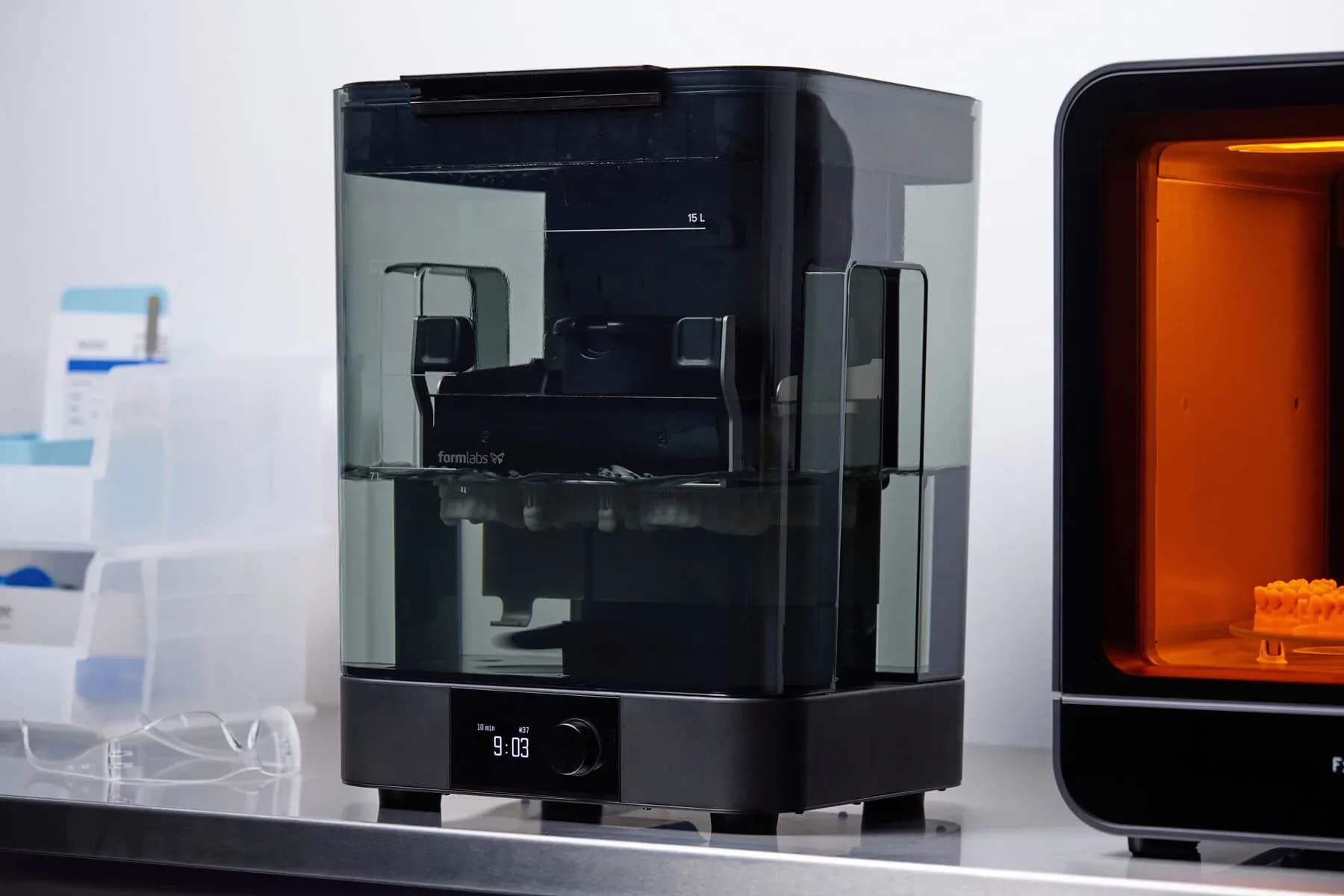
Formlabs datasheets list water absorption under ASTM D570: 0.66% for PA12 and 0.07% for PA11. The lower PA11 result informs selection. Fit needs a separate review of part dimensions, clearance and operating conditions.
What this number means
The value describes specimen mass gain in the water-absorption test. Percentage mass gain does not directly convert into percentage dimensional change or millimetres of required clearance.
The TDS also includes a separate table for a 1 × 1 × 1 cm cube exposed to media for 24 hours. For water, both sheets report 0.1% mass gain there. These results have their own test description; they do not replace the 0.66% and 0.07% ASTM D570 values.
The datasheets do not give a guaranteed dimensional change for our part. Fit adjustment must be checked for its geometry and environment.
Where this starts to cause problems
Formlabs PA12 guidelines distinguish two cases. For parts assembled after printing, the starting clearance is 0.2 mm for features below 20 mm² and 0.4 mm above 20 mm². For moving assemblies printed together, it is 0.3 and 0.6 mm respectively. These are design recommendations; they do not define an allowance for a month in humidity or a guaranteed dimensional tolerance.
- Repeated washing: specify temperature, cleaning agent and frequency.
- Unheated storage or a container: describe humidity and storage duration.
- Outdoor or boat parts: specify water type and contact duration.
- A moving assembly printed together: show gaps and the mechanism’s range of motion.
A looser fit can provide more room for dimensional change, but a part category such as a clip or cover does not establish its behaviour in humidity.
PA11 in contact with water
PA11 is worth considering for its lower water-absorption result. Selection also includes stiffness, temperature, force and duration. HDT at 1.8 MPa is 46 °C for PA11 and 87 °C for PA12. HDT describes specimen deflection in a test; allowable part service temperature must be assessed for the application.
PA11 requires individual confirmation of price, availability and production. International orders receive a reviewed quotation. Full results and test methods are on the PA12 and PA11 cards.
Why is there a note next to each number
Both sheets describe specimens conditioned for 7 days at 50% relative humidity and 23 °C. The manufacturer notes the influence of geometry, orientation and temperature. When comparing part measurements, record storage conditions and duration too.
Drying and measuring again
The TDS does not establish full recovery of dimensions and properties for an arbitrary part after drying. For a tight fit, measure before and after exposure and after any drying under an agreed procedure. Temperature, loading and chemical-exposure history form part of the test record.
A reprint a year later needs inspection against the drawing and actual mating feature. Comparable measurement conditions help assess differences; they do not by themselves guarantee that the new part fits.
What do we do with this in practice
- Establish humidity, temperature, medium contact time and washing method.
- For tight fits, agree the required clearance, critical dimensions and a fit test under application conditions.
- Compare candidate materials, including their properties and availability. Water contact alone does not determine the choice of PA11.
Walls, holes and starting clearances are collected in our design guidelines. Send your model for quotation with the mating feature and operating conditions; mark critical fit dimensions.
Sources: Formlabs Nylon 12 TDS (PDF), Nylon 11 TDS (PDF) and Fuse Series SLS Design Guide.