KNOWLEDGECosts3 MIN READ
How many parts fit in an SLS chamber and what affects price
Size, orientation and spacing affect build layout. Read the calculator’s part-count estimate separately from quotation and production preparation.
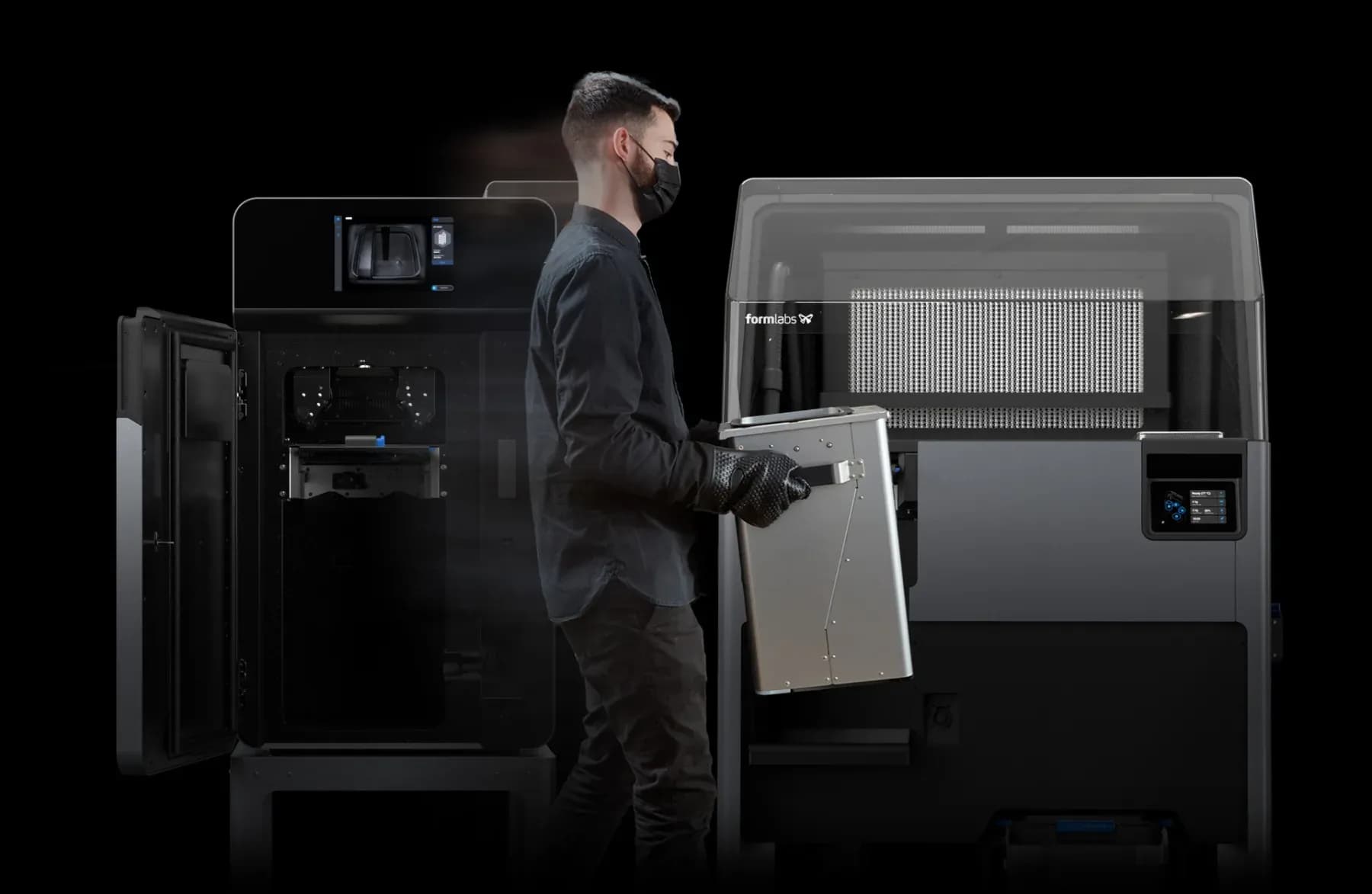
Chamber part count helps assess build utilisation. Order price also depends on material, preparation, finishing and delivery mode. Different builds may have different heights and process times.
The chamber is 165 mm, the part 159.8
The Fuse 1+ 30W chamber is 165 × 165 × 300 mm. We use a 159.8 × 159.8 × 295.5 mm part envelope for PA12. Single-part size and spacing between neighbours are separate requirements. A bounding box inside the envelope still needs orientation and geometry review.
How fill rate is calculated
Our calculator grid leaves 5 mm between part bounding boxes. It checks six axis-aligned box orientations and selects the highest count. Each axis fits whole parts with gaps between them. This is a geometry estimate; the production layout is reviewed in PreForm.
A 20 × 20 × 20 mm cube: 432 (6 × 6 × 12; 20 × 20 × 20 mm). A 96 × 96 × 28 mm wheel bounding box: 9 (1 × 1 × 9; 96 × 96 × 28 mm). A 150 × 100 × 10 mm plate: 20 (1 × 1 × 20; 150 × 100 × 10 mm). Brackets show the count along each axis and selected box orientation. The grid does not use model concavities or arbitrary tilts.
The highest-count layout may need to yield to strength, surface or dimensional requirements. Treat the estimate separately from a confirmed production build. See the orientation guide.
Second calculation: powder that is not sintered
Some powder remains unsintered after printing. Recovered powder is mixed with fresh powder according to material requirements. Build utilisation affects that balance. PA12 uses a 30% refresh rate; this is separate from chamber packing density and the mass of parts that can fit.
Material cost, process time and cleaning depend on the specific build. Grid count helps plan it; the quotation engine shows indicative pricing. Increasing packing density does not automatically change the published rates.
Where do the minimums and bulk discount come from
The Polish SLS B2B minimum is PLN 299.00 net. New-file preparation is PLN 150.00 net, once on first production. The minimum helps cover handling and production of a small order. A single ordered part may share a build with other jobs; it does not always pay for an otherwise empty chamber.
Batch mode: 8% discount, 10–14 business days. Standard: 5–10 business days. Quantity discounts: 100 parts: −5%, 500 parts: −8%, 1,000 parts: −10%. Terms come from the price list; layout and delivery are confirmed after model and production-availability review. Export terms require individual confirmation.
What this implies for design
- Reduce build height where part requirements allow. Rotation also changes surfaces, load directions and neighbouring layouts.
- A size change may fit more parts per row. Thinner walls affect mass and stiffness; check both.
- State the required quantity and delivery schedule. A full grid row does not guarantee a lower unit price.
- Provide powder-removal access to channels and cavities. Closed geometry needs review before printing is confirmed.
Upload the model in the calculator and enter quantity. The chamber view shows a simplified layout. A technologist checks orientation, powder removal and production scope. Without a model, send photos and a description.