KNOWLEDGETechnologies4 MIN READ
PA11 or PA12: how to choose between two polyamides
Two powders from the same family can produce very different parts. Compare impact strength of 71 versus 32 J/m, water absorption of 0.07 versus 0.66%, and stiffness in the opposite direction. Learn which figures matter and why datasheet temperatures can mislead.
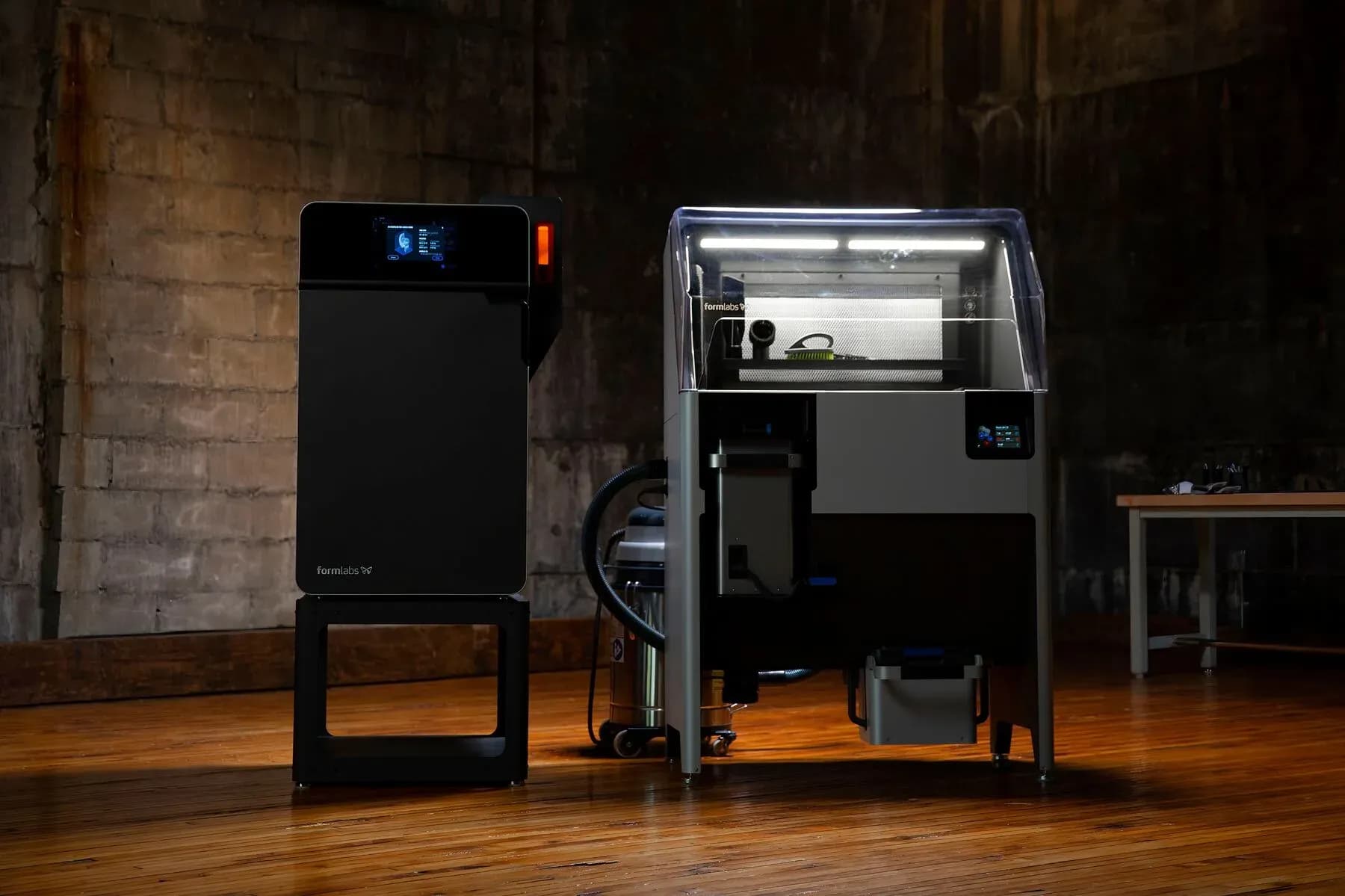
The question usually comes as 'which is better', but the answer depends on the part. Both are SLS polyamides. Specimen tests show differences in stiffness, ductility and impact strength; selection requires the geometry, loads and service conditions.
Five numbers that distinguish them
- Izod impact with notch: 32 versus 71 J/m. PA11 has the higher specimen-test result under ASTM D256-10. This does not guarantee that an arbitrary part will survive a drop.
- Elongation at break in X/Y: 11% versus 40%. This is a tensile-test result, not a reversible deflection range. PA12 has a separate 6% result in Z; the PA11 datasheet publishes 40% in X/Y only.
- Tensile modulus: 1,850 versus 1,600 MPa. The higher PA12 modulus describes specimen stiffness in tension; it does not determine creep under prolonged loading.
- HDT at 1.8 MPa: 87 versus 46 °C. The temperature at a specified specimen deflection under ASTM D648, not an allowable service temperature for the part.
- Water absorption: 0.66 versus 0.07%. ASTM D570 results. Mass change does not directly determine a dimensional or fit change after a particular period of use.
All values: samples conditioned for 7 days at 50% relative humidity and 23 °C, according to the powder manufacturer's TDS sheets. Without this note, numbers from additive printing are incomparable.
When to choose PA12
For rigid parts such as housings, brackets, fixtures or templates. The higher modulus is a reason to consider PA12. Fit, deflection and durability under constant loading must be assessed for the geometry, temperature and duration of the force.
The Polish SLS calculator gives an indicative PA12 price. International orders require a reviewed quotation. PA11 and TPU 90A also require individual confirmation of price, availability and production conditions.
When to choose PA11
For snap fits, hinges or parts exposed to impact. PA11 has higher impact strength and elongation at break in specimen tests. The 40% result does not mean a part returns to its shape after that deformation, or confirm a number of snap-fit cycles. Repeated deflection needs geometry review and application testing.
PA11 has lower water absorption in the ASTM D570 test. The 0.07% result does not guarantee unchanged dimensions in humidity. For fits, specify humidity, temperature, contact duration and required clearance. More in our article about absorption and fit.
The temperature on the card can be misleading
HDT describes the temperature at which a test specimen reaches a specified deflection under a test stress. At 1.8 MPa the result for PA12 is 87 °C and for PA11 46 °C. At the lower stress of 0.45 MPa the order reverses: 171 °C for PA12 and 182 °C for PA11.
0.45 MPa still means a load in the test. Neither figure is an allowable continuous service temperature for a part. The results help compare materials under the same conditions; selection requires the temperature at the part, exposure time, forces and mounting method.
Where does powder cost come from
Material cost depends on the powder price, fresh-powder refresh rate and chamber packing. A bag price does not describe the finished-part cost. We quote PA11 individually after reviewing the model, quantity and material availability; its price is not derived from the PA12 rate.
Three questions that resolve this
- Does the part need to bend or engage as a snap fit? Describe the deflection range, load and number of cycles; PA11 may be a candidate.
- Does it need to hold a fit or dimension under load and heat? Provide the force, temperature, service duration and a drawing of critical dimensions.
- Does it work in humidity or during washing? Specify the medium, concentration and contact duration; water absorption alone does not decide material suitability.
Full test standard tables are on the cards: PA12 and PA11. If the responses are contradictory, send us the model and explain what the part needs to withstand. Sometimes it's enough to thicken the wall and the question about powder disappears.
Specimen data sources: Formlabs Nylon 12 Powder TDS (PDF) and Formlabs Nylon 11 Powder TDS (PDF).