KNOWLEDGETechnologies3 MIN READ
Dip dyeing vs. colouring the material itself
How PA12 dyeing after printing differs from pigment throughout the plastic. Shade, penetration, fits and the sample to approve before a batch.
Post-print dyeing, pigment in a plastic and paint produce different results. For a functional part, agree the shade, fit and operating conditions before choosing the finish.
Bulk color is pigment in the granulate
In bulk-coloured plastics, pigment is mixed into the base material before forming, so colour extends through the section. Our PA12 dyeing treats a finished print and does not mean pigmenting the entire part mass.
The powder is gray or white
Our dyeing offer covers PA12. Base powder shade affects the bath result: grey and white prints can give different colours with the same dye. We assess the choice on a physical sample.
Sintered material is porous and that is an advantage
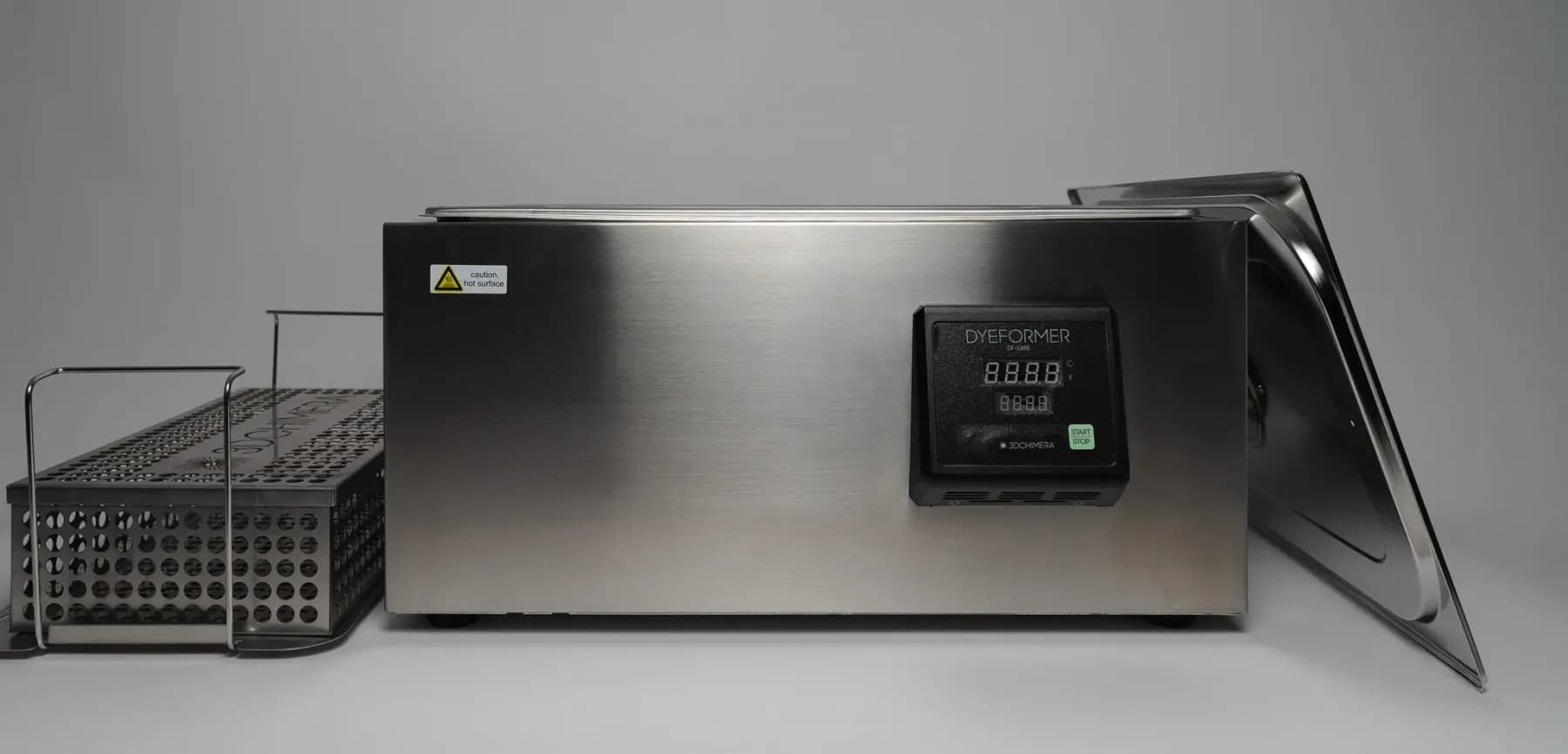
In the Dyeformer, the heated bath lets dye enter the polymer surface. The manufacturer gives a 1 h cycle; parts need drying afterward. A 495 × 292 × 152 mm tank does not describe the capacity of any batch: basket size, geometry and preparation matter.
Equipment specifications: 3DChimera, Dyeformer DF1680. Bath time is one order stage alongside cleaning, drying and inspection.
Dyeing and a paint coating
Paint forms a layer whose thickness needs allowance at fits and fine lettering. Dyeing adds no such coating. This does not guarantee unchanged dimensions: critical surfaces and measurement after finishing are agreed before production.
Abrasion, cutting or drilling a dyed part may expose a different shade. We do not publish our penetration depth without a cross-section measurement.
Penetration depth and machining
Xometry describes dye penetration up to 0.25 mm in its offering. That describes their process; it is neither a measurement of our part nor evidence of greater Dyeformer penetration.
Comparison source: Xometry Europe, SLS dyeing. A wear-exposed part needs assessment of the surface and operating conditions.
Where the eight colors come from
Our palette contains 8 colours. Available shades are industrial black, crimson, green, blue, violet, orange, yellow, turquoise. Current statuses are on the dyeing page; a supplier catalogue does not establish our availability.
Orange, yellow and teal remain in preparation. Our choice of a light base considers Nylon 12 White and a nitrogen atmosphere. A screen colour cannot replace an approved sample.
What else we don't know
We do not publish UV, abrasion or solvent resistance for our colours without testing. Specify light exposure, friction and chemicals. Raw PA12 TDS results are not tests of the dye.
We send a dyed sample before a batch. A Pantone or RAL reference supports colour selection; the physical sample approves the shade. We do not promise a match based on a monitor preview.
What this means for your order
Black is available now. Printing with dyeing is quoted from 20 parts. Give quantity, deadline, colour and critical fits; we confirm the complete order schedule after reviewing those requirements.
Process and colour statuses: PA12 dyeing.
Base properties: PA12 datasheet.
Start a quote for your own model: calculator.